The Pixar movie, Hoppers (Chong, 2026), follows an animal-loving college student, Mabel, who transfers her mind into a robotic beaver, where she communicates with animals to save her grandma’s forest glade from destruction.
The film starts off with Mabel as a young, kind of wild elementary school girl. We are introduced to her as she attempts to liberate all the classroom pets in the school. She is caught by the teachers, who realize she is at it again. There is a chase, and Mabel bites a staff member, prompting a school disciplinary visit and mom leaving Mabel with her grandmother Tanaka for the day.
Tanaka [finds Mabel having run off, upset, and having climbed a tree in her expansive forested property]
So, what’d they book you for this time? [Pause]
The outlaw’s life is pretty lonely, huh? [Pause]
All right, you leave me no choice. [Walks away, to a glade, sits on a large rock in front of a pond, and waits for Mabel to join]
Come on. [patting space next to her] When I was 12, I punched Suzie Perkins in the face. I used to get really mad, but not anymore. Wanna know my secret? You just have to be very still and watch and listen.
[Through the eyes of Mabel, we see her calm herself through seeing the nature, wildlife, and a sense of awe of the systems around her]
Feel better? [Mabel Nods]
That’s what nature does. It’s hard to be mad when you feel like you’re part of something big.
Mabel: Grandma, can I come here every day?
Tanaka: Anytime you want. It could be our special place. You and me.
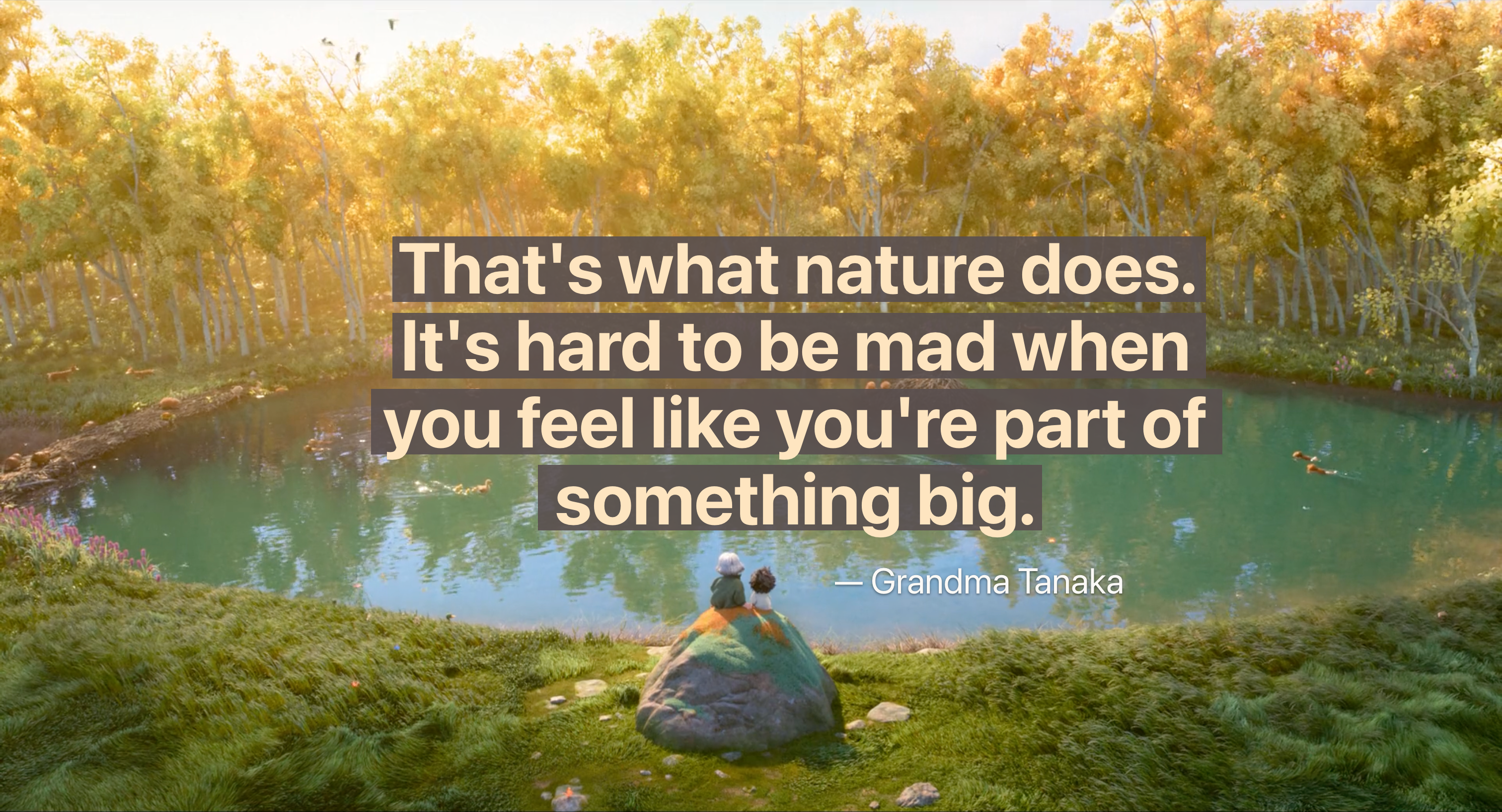
I love this scene, and the visual it provides of a scientifically backed phenomenon. Bratman et al. (2019) provide a consensus review including a broad interdisciplinary breadth of authors who describe concurrence that evidence supports associations between common types of nature experiences and
- an increased psychological well-being
- a reduction of risk factors and burden of some types of mental illness
At the same time, opportunities for some types of nature experiences are decreasing in both quality and quantity for many people globally.
This summer, I would encourage you to seek opportunities to have nature experiences, especially those that inspire feelings of awe and connection to a greater whole (Capaldi et al., 2015). For me, I love many outdoor activities. Some of these are things I do locally and don’t take significant extra effort (for example, afternoon bike rides or walks along the river), and some include more planning and going places (such as camping, backpacking, visits to the Oregon Coast, day hikes). I find it helpful to calendar out some activities you want to do over the summer, that you are endeavoring to accomplish. Make sure some of those activities include touching lots of grass.
Reference
Bratman, G. N., Anderson, C. B., Berman, M. G., Cochran, B., de Vries, S., Flanders, J., Folke, C., Frumkin, H., Gross, J. J., Hartig, T., Kahn, P. H., Kuo, M., Lawler, J. J., Levin, P. S., Lindahl, T., Meyer-Lindenberg, A., Mitchell, R., Ouyang, Z., Roe, J., …, Daily, G. C. (2019). Nature and mental health: An ecosystem service perspective. Science Advances, 5(7), eaax0903. https://doi.org/10.1126/sciadv.aax0903
Capaldi, C., Passmore, H.-A., Nisbet, E., Zelenski, J., & Dopko, R. (2015). Flourishing in nature: A review of the benefits of connecting with nature and its application as a wellbeing intervention. International Journal of Wellbeing, 5(4), 1-16. https://doi.org/10.5502/ijw.v5i4.449
Chong, D. (Director). (2026) Hoppers [Film]. Pixar
Tags: Social Work Heritage University Link Post Self Care
Related